



Whenever March Madness fever kicks in, people look to create contest pots and other fun activities for the tournament. March Madness squares offer a fantastic way to engage with the event, regardless of your basketball knowledge. Most importantly, it’s all about having fun! Many intrigued players pose the same question: How do March Madness squares work? Keep reading as we delve into everything you need to know about March Madness squares.
How Are March Madness Squares Chosen?
In a March Madness squares contest, the grid is filled before numbers are even drawn. Each person picks one or more squares on a 10×10 grid, without knowing which numbers will eventually be assigned to the rows and columns. After all squares are claimed, numbers 0–9 are randomly assigned to both axes, usually one representing the last digit of each team’s score.
This randomness ensures fairness and prevents players from targeting only statistically favorable numbers.
What Is a March Madness Square?
A March Madness squares template is an 11×11 grid where players choose a spot on the grid. It’s laid out as follows:
The contest pot then uses the square for every game in the tournament, offering many chances to enjoy the fun.
Check the latest free NCAAB odds and put your fortune to the test.
How Are Numbers Assigned in March Madness Squares?
Once every square on the grid is filled, it’s time to assign numbers. Here’s a simple method:
- Write numbers 0–9 on slips of paper.
- Draw them randomly to fill the top row (Team A) and left column (Team B).
- These numbers now represent the last digit of each team’s score.
This process ensures that each participant’s pick remains fair and unpredictable, regardless of how they selected their squares.
How Do You Run a Squares Contest Pot for the NCAA Tournament
Each entrant into the contest pot has the chance to win in every game. Each square contest pot can set its own rules for counting scores. Whether it’s whoever gets the most correct squares or squares later in the tournament that award more points, it’s up to you!
Players have the freedom to set up the square in various ways. Whether it’s with co-workers or friends, on paper, or digitally, the choice is entirely yours. This flexibility is what makes it a fun and enjoyable way to experience March Madness.
What Numbers Give You the Best Chance in March Madness Squares?
Not all numbers are created equal when it comes to March Madness squares. Since the final digits of college basketball scores aren’t evenly distributed, some combinations appear more frequently.
Based on historical data:
- 0, 1, 2, 3, 4, 7 tend to appear most often
- 5, 8, 9 are less frequent
- The combination 7-0 or 0-7 is statistically strong
These trends are helpful when analyzing how March Madness squares work—but remember, the number assignments are random, so there’s no guaranteed strategy.
Common Margins of Victory in March Madness
Margins of victory can help explain which final score combinations are more likely—and why some squares win more often.
Most Frequent Margin of Victory Ranges
| Margin (Points) | Frequency |
| 1–4 | High |
| 5–9 | Moderate |
| 10+ | Less frequent in close games, but common in early rounds |
Close games dominate late-round matchups, meaning lower margins may be more relevant as the tournament progresses.
MOV End-Digit Trends
The last digit of the margin of victory (MOV) also matters. Certain digits appear more frequently due to scoring patterns and free-throw-heavy endings:
- 0, 1, 3 – Appear more often
- 6, 9 – Appear less often
This data supports which square numbers are more likely to hit.
How Do You Read March Madness Squares?
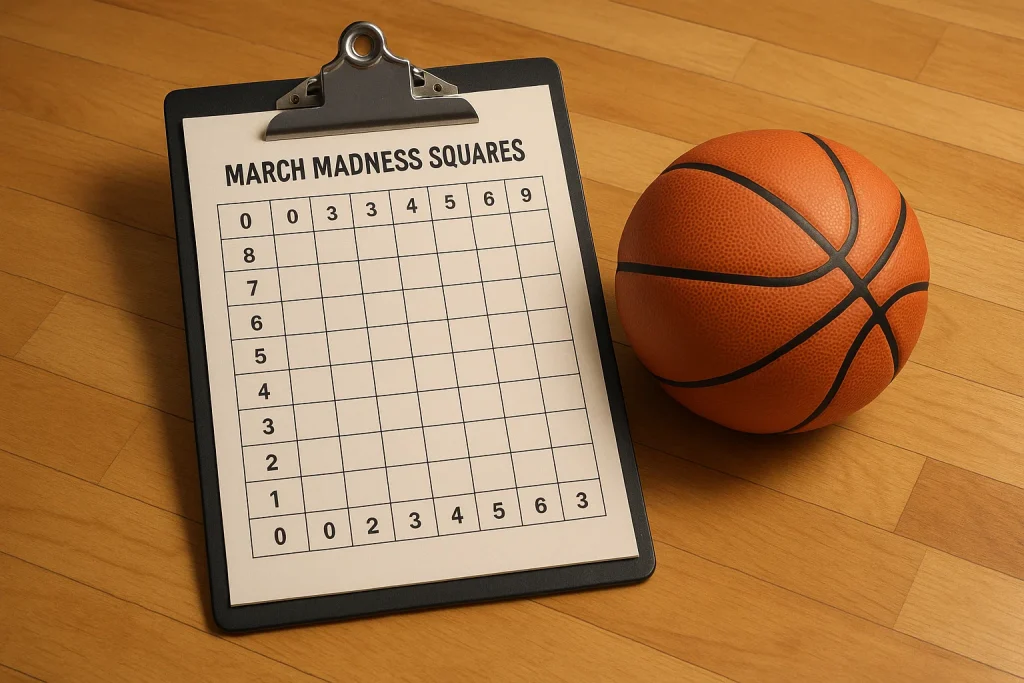
Reading a March Madness square is straightforward. The numbers on the top relate to the winning team, and the numbers down the left relate to the losing team. Players must follow these steps to read their NCAA square:
- Check the score from the game,
- Find the last digit of the winning team’s score,
- Find the last digit of the losing team’s score,
- Match the winning digit to the top row,
- Match the losing digit to the left column,
- Cross-reference both numbers to find the winning square.
Each square contains a contest pot member, so the winner of the round is the one whose square the score leads to.
What Does It Take to Win in a March Madness Squares Game?
To win, your square’s coordinates must match the last digit of each team’s score at a specific point in the game—often halftime or final score.
Example:
If the score is Team A: 73, Team B: 68
- The winning square would be (3, 8)
Depending on your pool’s rules, there may be multiple winning moments (at the end of each half or quarter), giving you more chances to win. That’s why understanding how do March Madness squares work helps maximize your engagement with the game.
What Are the Most and Least Frequent Winning Squares?
If you’ve ever wondered why certain squares never win, there’s math behind it.
Most Common Winning Squares
- 0–0, 0–7, 7–0, 3–3
These combinations often occur due to basketball’s scoring structure, which involves multiples of 2 and 3.
Least Common Winning Squares
- 2–9, 5–8, 8–5
These appear less frequently in final digits, making them harder to hit.
So while March Madness squares are random, stats suggest some picks perform better than others over time.
How to Make a March Madness Bracket Pool?
Players can make a March Madness bracket contest pot in two ways;
Manually
The manual method involves printing out the square and filling it in with people who want to join the contest pot. For each game in the tournament, the person in charge checks the square and records all winners. This method takes a little longer than more modern methods, but many people find it to be the most enjoyable way to play.
Virtually
Virtual March Madness squares are available, removing the hassle behind running a contest pot. If you’re involved in a contest pot where people can’t meet regularly, it’s an excellent way to run the event.
How the March Madness Selection Committee Works
The NCAA selection committee, comprising athletic directors and conference commissioners, determines which 68 teams will participate in the tournament. They base decisions on:
- Overall record
- Strength of schedule
- Key wins and losses
- NET rankings and advanced metrics
Understanding this process adds more context as the tournament unfolds—and makes every square feel a little more meaningful.
What Is an At-Large Bid—and Who Gets One?
While 32 teams earn automatic bids by winning their conference tournaments, the remaining 36 spots are at-large bids. These awards go to teams that didn’t win their conference but had strong overall seasons.
This means even teams that fall short in their tournament have a shot, creating suspense that keeps brackets and squares exciting.
What Do Seeds Mean in March Madness?
Each team is “seeded” based on how strong they’re perceived to be:
- 1-seeds are considered elite
- 16-seeds are long shots
Seeding plays a big role in predicting matchups—and potential blowouts, which could affect your square’s odds depending on the round.
March Madness Squares Rules
The rules behind a March Madness square vary between contest pots. Everyone has their own way of playing. Here are some of the most common rules players can add to their contest pots:
- The numbers are preset before choosing squares
- The numbers are randomly selected after choosing squares
- Each winning square is worth a point
- Winning squares later in the tournament are worth more
Players can set their own rules, so there’s no need to adhere to these specific choices. For anyone looking to pick the numbers randomly, a deck of cards is a superb way to mix things up, but there are also random number generators online.
Looking for a Printable March Madness Squares Grid?

If you’re organizing a March Madness prediction offline, a printable March Madness squares grid can make setup easy. The standard format is a blank 10×10 grid with space to write names before numbers are drawn. You can also find pre-filled templates that include random number assignments if you’re short on time.
Printables are especially popular for office contests or parties where digital tools aren’t needed.
Results and Winning Squares
The contest pot checks the square whenever a tournament game occurs. The contest pot manager adds the result to the contest pot listings, and whoever gets the highest score at the end of the tournament is the winner. It’s an excellent way to add fun to March Madness season, and players can find all the results as they take place here at Sportzino.

 Share on