





Whether you’re new to hockey or just looking to deepen your understanding, learning how to read NHL odds is a great way to engage more with the sport. Odds provide insights into expectations, potential outcomes, and how each team is projected to perform, without relying solely on gut feeling.
How Do the Hockey Odds Work?
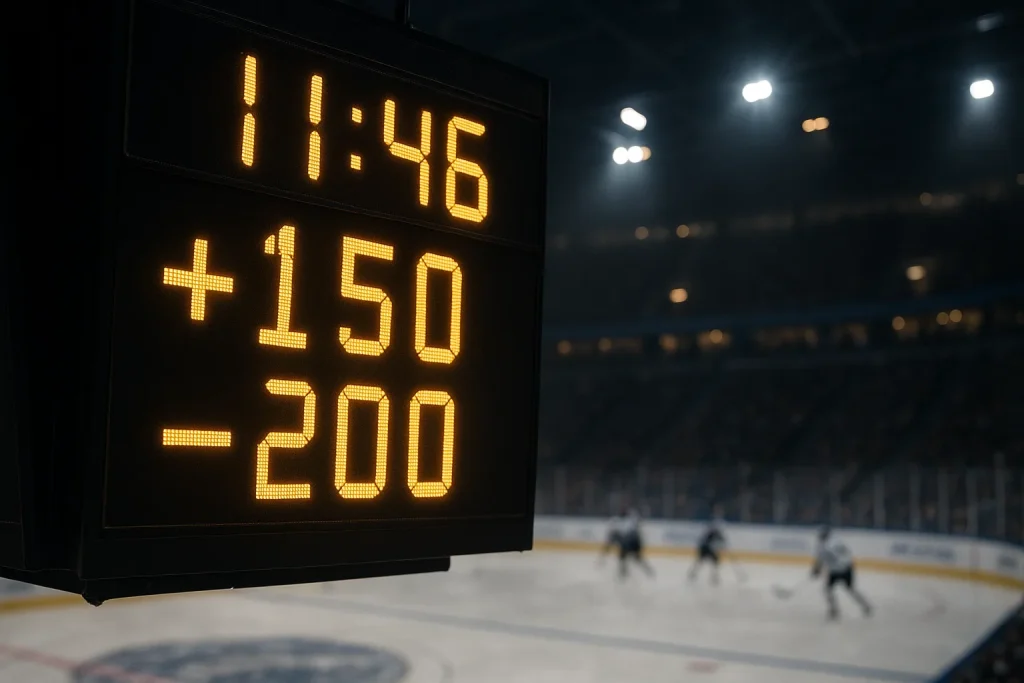
At their core, NHL odds represent the probability of a specific outcome happening and the potential return associated with it. These odds help fans understand which team is favored and by how much. They also vary depending on the type of play, region, or sportsbook format.
What Are the Different Types of NHL Odds?
Although we provide plenty of different events to make predictions, how odds are expressed won’t be the same for everyone. So, our guide covers the three most common forms of odds. Keep reading to learn about decimal, fractional, and American NHL odds.

Decimal NHL Odds
Decimal odds are the most common way to express payouts. Although American odds are most familiar to US players, decimal odds appear more often worldwide. As the name suggests, they express the odds as decimals. They’re the simplest to understand of all odds, but they still require some mathematical reasoning to work them out. Examples include:
- Decimal odds appear in the form of 1.25,
- In this case, players who use 10 Sweep Coins to make a prediction must multiply their coins by the decimal number to get their return,
- So, it would be 10 x 1.25,
- It gives a return of 12.5 Sweep Coins,
- It breaks down as 10 Sweep Coins back for making the prediction and 2.5 Sweep Coins as profit.
So, to break it down further, the number must always be above 1, as this considers the Sweep Coins used when predicting. So, to work out what the profit will be, users can take 1 away from the decimal number, and then the remaining decimal multiplied by the number of Sweep Coins returns the profit.


Fractional NHL Odds
Fractional odds are a common form of expressing odds in Europe. They’re specifically the traditional way in the UK, emanating from horse racing. As the name suggests, they appear as a fraction, so it requires more work to understand potential payouts. Users must follow these steps to work out the payout for odds of 7/4.
- Divide the total Sweep Coins by 4,
- Multiply the answer to the previous step by 7,
- Add the answer to the original number of Sweep Coins.
So, users must divide by the denominator and multiply by the numerator to calculate the total profit. But, to work out the total payout, players must add the profit to the number of Sweep Coins used when making the prediction.
Although it’s a traditional method of expressing odds, it is complicated when using awkward fractions. As a result, many players prefer to use decimal odds. However, it’s still a relatively straightforward process for simple fractions, with 2/1 being an example that users will be able to handle.
American NHL Odds
American odds work in two ways for the NHL. The first example relates to the favorite, and the second relates to the underdog. If the odds appear with the negative sign before the number, it’s the favorite, and a plus sign means it’s the underdog.
The favorite odds will be expressed as -125. In this situation, players will need to use 125 Sweep Coins to gain 100 Sweep Coins as profit. So, the total return will be 225 Sweep Coins. The number after the negative is always how many Sweep Coins users will have to use for their pick to return 100 Sweep Coins as profit. As another example, -150 would require 150 Sweep Coins.
The underdog looks different and uses a different way to calculate returns. It will show odds in the form +155. In this case, using 100 Sweep Coins will return a profit of 155 Sweep Coins. The total return would be 255 Sweep Coins.
It’s a more complicated system than decimal and fractional odds, but it’s more familiar to the US audience. As a result, many users will prefer this method of expressing odds as they’re more used to it.
What Are the Types of Hockey Picks?
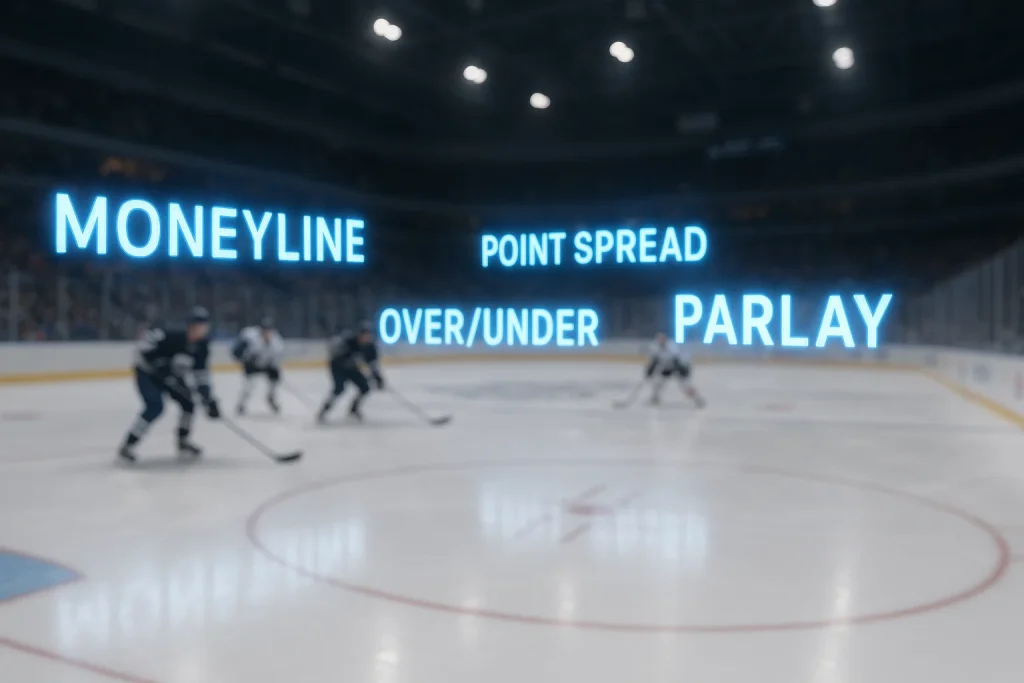
After learning about odds, we’ve also covered some of the most common picks. Although not an exhaustive list, these predictions are the most popular with players and will allow you to use your new skills in reading NHL odds.
Moneyline
The moneyline is the most common prediction for all sports. It’s essentially choosing which team will win the game. There are two types of moneylines to understand when learning how to read lines in Hockey. The first is a 2-way pick. Here, viewers choose which of the two teams they think will win the game. The second is a 3-way pick. In this selection, a tie is available.
In a 2-way pick, if the game ends in a tie, it will typically void the prediction. However, certain games sometimes have different rules, impacting whether it voids the pick or counts as a loss.
Point Spread
A point spread works as a handicap. It allows users to predict a game and choose the favorite while getting more positive odds. An example would be picking the favorite with a point spread of -1.5, increasing the odds for a better payout. In this example, if the favorite wins the game 2-0, the prediction also wins. Because the handicap removes 1.5 points from the favorite’s score, a 2-0 win is theoretically a 0.5-0 win.
They can also work as a positive handicap. So, choosing the underdog in the game may add a +1.5 handicap. If the underdog loses 1-0, the prediction wins as the spread adds 1.5 points to their score. The odds work differently to a negative spread, as it reduces the odds rather than increasing them.
Over/under
The over/under market is an excellent way to make predictions on aspects other than the winner of the game. An example of the over/under market is predicting the number of goals in a game. So, if the market is over 2.5 goals, the prediction will be correct as long as at least three goals happen for either team. The concept applies if choosing the under 2.5 goals, but it must be less than three goals in the game.
It doesn’t have to be the goal market for over/unders, either. Players can make predictions on stats like fouls, too. It adds plenty of extra fun when making predictions on NHL matches.
More Ways to Engage With Hockey Odds
Aside from the traditional formats, there are many other ways to experience the thrill of NHL action.
Parlays
Combine multiple outcomes into one entry. All selections must be correct for the parlay to succeed.
Same-Game Parlays
Focus on multiple outcomes within a single game, like picking the winner and a player to score.
60-Minute Line
Only counts the result at the end of the regulation. If the game goes to overtime, this option does not apply.
Grand Salami
This unique market totals the number of goals scored across all NHL games on a given day. You choose over or under the set line.
Live/In-Game Wagering
These options are available as the game unfolds, allowing fans to respond to real-time momentum shifts and trends.
Prop Picks
Focuses on individual performances, like who will score the first goal or how many shots a goalie will face.
Futures
Long-term predictions, such as who will win the Stanley Cup or earn MVP honors.
Derivative Markets
Includes more niche or time-specific options, like which team will score first or the result after one period.
NHL Strategy and Tips for Making Informed Picks

Understanding odds is just the first step. Smart decisions often come down to context, trends, and analysis.
Matchups Matter
Analyze recent head-to-head records, home vs. away performance, and style of play between teams.
Track Injury Reports
Even one key player sitting out—especially a starting goalie—can swing a game’s odds significantly.
Watch Line Movement
Shifting lines can indicate where the majority of the market is leaning. Sudden changes may signal late-breaking news or sharp insight.
Referee Trends
Some officials call more penalties than others, which can impact power play opportunities and scoring chances.
Situational Angles
Back-to-back games, travel fatigue, or emotional letdowns after big wins can all affect team performance.
Team Trends
Look for patterns, such as a team consistently starting strong in the first period or going over the total in road games.
How to Make a Hockey Pick Step-by-Step
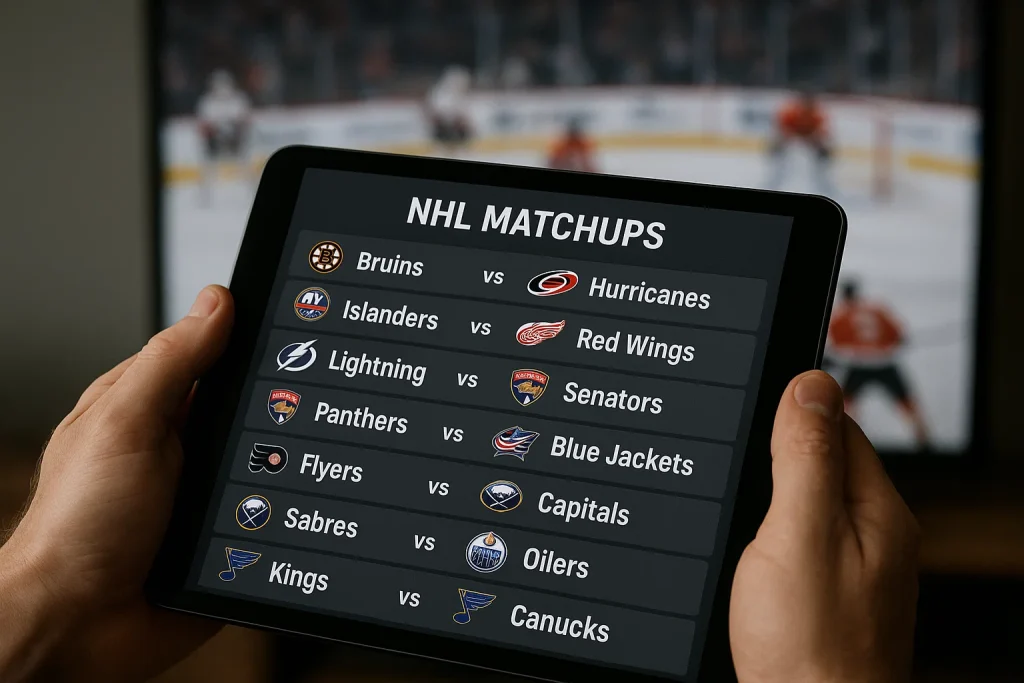
1. Explore Matchups
Review upcoming games and statistics on a reliable matchup page.
2. Compare NHL Lines
Use trusted tools to compare odds across multiple platforms and find the most favorable line.
3. Sign In or Register
Choose a verified provider in your region and create an account if you haven’t already.
4. Finalize Your Pick
Once you’ve done your research and selected your options, confirm your selection.
NHL Line Movement: What It Tells You
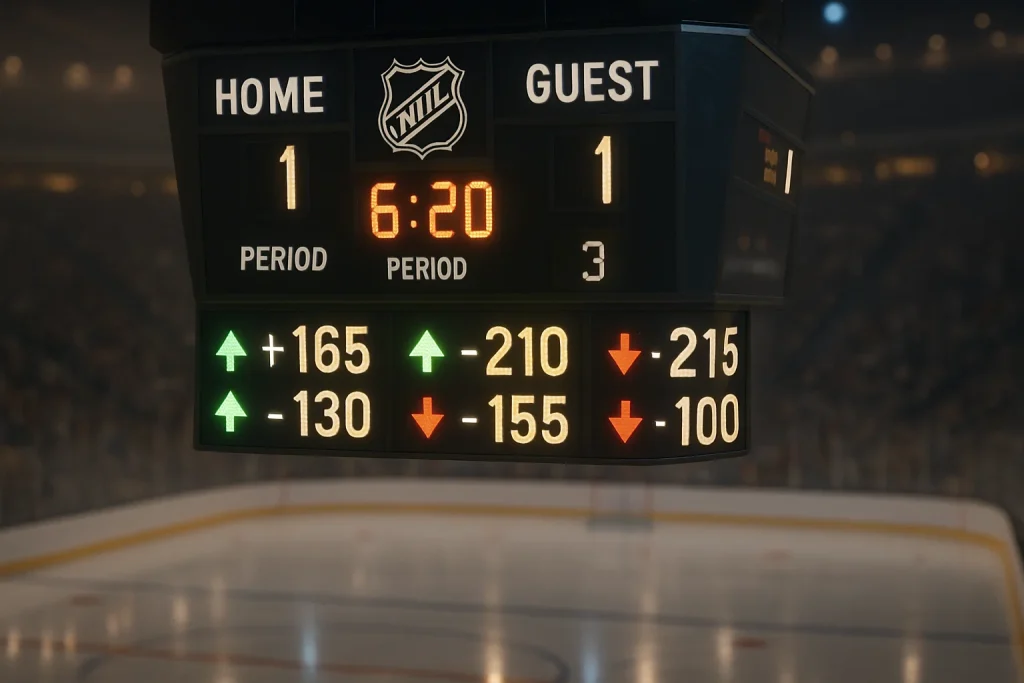
Odds are not static. Movement in NHL lines is common and can reflect new information, such as lineup changes or weather conditions for outdoor games. Monitoring these shifts can help you lock in the best value at the right time.
Exploring the Biggest NHL Events

Some NHL events attract significant fan and market interest, and often unique odds formats.
Stanley Cup Finals
As the league’s biggest event, the Cup Finals draw heavy coverage and competitive lines.
All-Star Weekend
Fun and unpredictable, this event is packed with player props and specialty formats.
Playoffs
Tight matchups and extended series add layers of complexity and new opportunities.
Opening Night
Teams often come out with energy, but rust or new lineups can produce surprising results.
Player Awards
From Hart Trophy (MVP) to Vezina (top goalie), these long-term lines offer great insight into season-long narratives.