

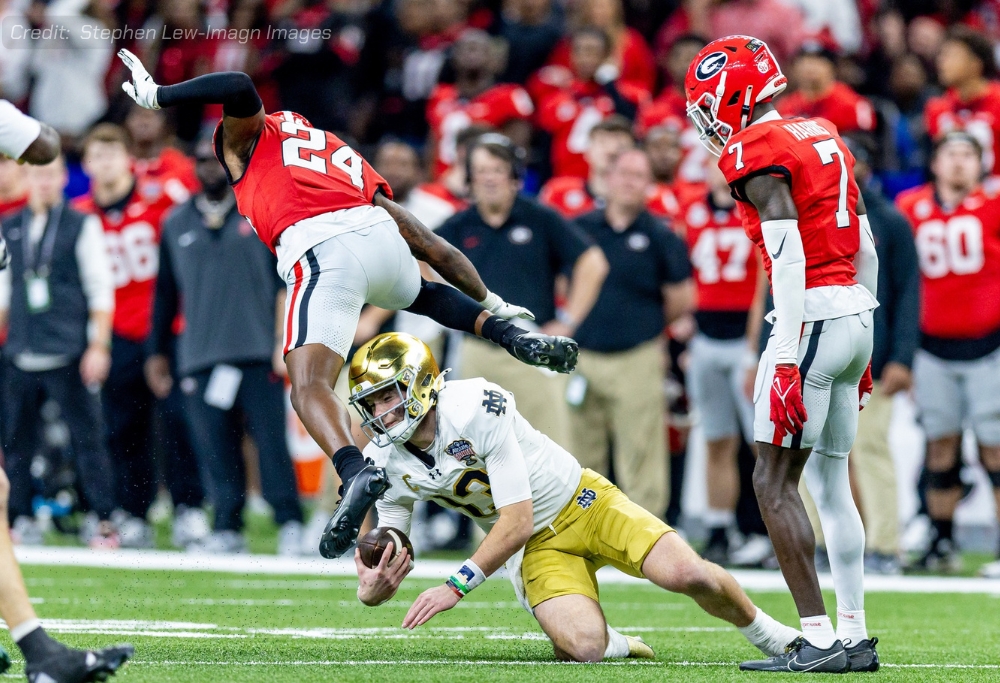
A dominant safety is a crucial piece of an elite NFL defense, and NFL teams are now looking ahead at the upcoming draft. NFL defenses are forced to send help down the field without a dominant safety, which leaves them vulnerable to big run plays up the middle. Several high-profile prospects are available in the 2025 NFL draft, and here are the predictions for the 2025 NFL draft ranking at the safety position.


Top 10 Safeties Prospects for the 2025 NFL Draft
| Player | School |
| Malaki Starks | Georgia |
| Nick Emmanwori | South Carolina |
| Kevin Winston Jr. | Penn State |
| Xavier Watts | Notre Dame |
| Billy Bowman Jr. | Oklahoma |
| Andrew Mubuka | Texas |
| Malachi Moore | Alabama |
| Jonas Sanker | Virginia |
| Sebastian Castro | Iowa |
| Lathan Ransom | Ohio State |
A wide variety of safeties is available in the upcoming NFL draft, with the 2025 NFL draft being pegged as one of the best in recent memory at the safety position. In the modern-day NFL, shutdown safety is crucial to every elite defense. The ability to go one on one with the opponent’s receivers opens up the field for the rest of the team to make game-changing plays. The upcoming class of safeties boasts a wealth of talent, with two potentially game-changing safeties dominating the draft board.
Malaki Starks and Nick Emmanwori could both be first-round picks, and the pair will have to wait and see who gets the honor of the top selection for their position. Starks can truly do it all, as his physicality, straight line speed, and strong open field tackling abilities make him not only the best safety of this draft class but also one of the more highly anticipated prospects at this position in the last decade. Emmanwori would likely be pegged as the top prospect in any other year. His ability to shut down big passes down the field while still having the strength to stop the run makes him a great fit in almost any NFL defense. Without further ado, here is the 2025 NFL draft ranking at the safety position with the strengths and weaknesses of these potentially game-changing players.
1. Malaki Starks – Georgia
Strengths
- Run defense
- Open field tackling
- Ballhawking skill
Weaknesses
- Too aggressive on pass defense
- Needs to calm down in big moments
NFL Fit
- Dallas Cowboys
- Indianapolis Colts
2. Nick Emmanwori – South Carolina
Strengths
- Experience
- Run defense
- Pass breakups
Weaknesses
- Poor coverage early in career
- Struggles with instincts on jumping routes
- Multiple costly pass interference penalties
NFL Fit
- Miami Dolphins
- Indianapolis Colts
3. Kevin Winston Jr. – Penn State
Strengths
- Physicality and size
- Downfield speed
- Can play multiple positions
Weaknesses
- Injury concerns
- Costly mistakes in big games
- Easily fooled in play-action schemes
- Slender build—will need to widen out
NFL Fit
- Dallas Cowboys
- Green Bay Packers
4. Xavier Watts- Notre Dame
Strengths
- Well-rounded physical attributes
- Can bounce off contact, strong for his size
- Pass Breakups
Weaknesses
- Slow for a safety
- Struggled in the middle of the field
NFL Fit
- Dallas Cowboys
- New England Patriots
5. Billy Bowman Jr. – Oklahoma
Strengths
- Two way player
- Thrives in one on one coverage
- One of the few strong safeties available
Weaknesses
- Open field tackling
- Effectively using his speed
NFL Fit
- Baltimore Ravens
- Miami Dolphins
6. Andrew Mubuka – Texas
Strengths
- Getting better with age
- High ceiling
- Excellent ball contestor
Weaknesses
- Not a lot of big game experience
- Small sample size in early years
NFL Fit
- Washington Commanders
- New York Giants
7. Malachi Moore – Alabama
Strengths
- Experience- 3,100 snaps
- Can play multiple positions effectively
- Thrived since moving to safety
Weaknesses
- Lack the highlight reel hits
- Small for an NFL safety
- Slow hands when disengaging blocks
NFL Fit
- Miami Dolphins
- Indianapolis Colts
8. Jonas Sanker- Virginia
Strengths
- Deep ball specialist
- Good instincts in the open field
- Excellent tackling capabilities
Weaknesses
- Lacks physical attributes
- Not too fast or strong
NFL Fit
- Arizona Cardinals
- Indianapolis Colts
9. Sebastian Castro – Iowa
Strengths
- Size to Defend Tight Ends
- Run Defense
- Sticks to Position well
- Agile footwork
Weaknesses
- Short build limits ceiling
- Poor top speed
NFL Fit
- Denver Broncos
- Chicago Bears
10. Lathan Ransom – Ohio State
Strengths
- Height and length needed for big receivers
- Excellent footwork
- Hunts contact
Weaknesses
- Slender build
- Gets caught with eyes upfield
NFL Fit
- Chicago Bears
- Arizona Cardinals
Factors NFL Teams Consider When Drafting Safeties
NFL teams use several key factors when scouting potential options at the safety position. True safeties don’t get called on often, but when they do, they have the potential to make game-changing plays. The ability to stay focused when not getting targets is crucial to surviving at the safety position and is a massive factor when NFL teams are potentially using a high draft pick at the safety position.
There are two major attributes every good safety needs to have, and that is pass coverage and run stopping. A safety’s value hinges on their ability to break up big shots down the field. Not only do they need to match the speed of opposing receivers, but they also require exceptional footwork to prevent falling behind. Acceleration and deceleration can be more important than straight line speed, as there are fewer and fewer go routes in the modern day NFL.
The second major attribute every good safety needs is the ability to stop the run. Safeties can no longer hide down the field on run plays and need to be able to stop the runs up the middle. Safeties are often the last line of defense before a running back breaks into the open field, and their ability to make solo tackles when their team needs it most is crucial for NFL caliber safeties.
Drafting a good safety can instantly transform an average defensive unit into a top NFL defense. There are several factors NFL teams consider when potentially drafting a safety, and the ability to avoid pass interference penalties is one that often gets overlooked. College football has a flat 15-yard penalty for pass interference, while it is a spot foul in the NFL. Some of these safeties have gotten used to taking an intentional penalty if they get beat down the sideline, which will cost their teams dearly in the NFL.

 Share on